
Russian World
Tagsimperial narrativesoft powercivilizational claimintervention pretext
EquivalentsRUРусский мир
Definition
Section titled “Definition”Russkiy mir (“Russian world”) is a civilisational doctrine that imagines Russia as the centre of a transnational community bound together by the Russian language, Orthodox Christianity, and a shared imperial and Soviet memory — a community whose extent is defined by culture and loyalty rather than by the borders of the Russian Federation. In Kremlin usage the concept converts language and faith into a claim of jurisdiction: wherever a “Russian world” is said to exist, Moscow asserts a special right to speak for it, and ultimately to act on its behalf.
The frame is foundational. Most other narratives in this dictionary are downstream of it: the Compatriots Abroad category, the Novorossiya territorial project, the demonisation of a decadent Collective West, and the export of Traditional Values all presuppose that a single Russian civilisation exists and is under threat.
Origin and history
Section titled “Origin and history”The phrase has deep roots in Russian intellectual history, but its modern, state-sponsored revival began in the 2000s. In 2007 Vladimir Putin established the government-funded Russkiy Mir Foundation by decree, co-founded by the foreign and education ministries, to promote the Russian language and culture abroad and to cultivate the diaspora as an asset of Russian foreign policy.1
The concept acquired an explicit religious doctrine through the Russian Orthodox Church. In 2009 the newly enthroned Patriarch Kirill defined the “Russian world” as a common civilisational space founded on “three pillars: Orthodoxy, Russian culture and language, and common historical memory,” binding faith, language, and empire into a single identity.2 Scholars including Marlene Laruelle and Mikhail Suslov have traced how the idea migrated over the following decade from a relatively benign soft-power and diaspora programme into a hard geopolitical doctrine that, after 2014, supplied a civilisational rationale for territorial revision.3
Function in propaganda
Section titled “Function in propaganda”The frame is used to:
- recast the borders of the Russian Federation as artificial, implying that the “real” Russia extends to wherever Russian is spoken or Orthodoxy is practised;
- convert language and faith into a standing pretext for intervention, since a threat to the “Russian world” anywhere can be presented as a threat to Russia itself (see Compatriots Abroad);
- supply a positive identity defined against the West, casting Russia as a distinct, morally superior civilisation besieged by a decadent Collective West and its Gayropa values;
- sacralise the state and its wars, lending Kremlin policy the authority of the Church and framing aggression as the defence of a holy civilisation.
The claim is ideological, not descriptive. Speaking Russian or belonging to an Orthodox church does not make a person a subject of the Russian state; Ukraine, Kazakhstan, the Baltic states and others contain large Russian-speaking populations who are citizens of independent countries with their own loyalties. The doctrine deliberately erases the distinction between a language community and a political jurisdiction.
Key examples
Section titled “Key examples”The Russkiy Mir Foundation (2007). The foundation institutionalised the concept, funding Russian-language centres, media, and cultural programmes worldwide and knitting diaspora organisations into a network aligned with Moscow’s interests.1
Putin’s 2021 essay. In “On the Historical Unity of Russians and Ukrainians” (July 2021), Putin argued that Russians and Ukrainians are “one people” artificially divided, and that Ukrainian statehood is a historical error — a direct application of russkiy mir logic that denied Ukraine a separate existence on the eve of the full-scale invasion.4
The theologians’ rebuttal (2022). In March 2022, a large group of Orthodox scholars issued “A Declaration on the ‘Russian World’ (Russkii Mir) Teaching,” condemning it as a false and heretical ideology that fuses church and ethno-nationalist empire to justify war.5
A pop anthem of the doctrine (2024). The Kremlin-aligned singer Oleg Gazmanov — sanctioned by Canada and barred from the Baltic states over his backing of the war, and a performer at Putin’s March 2022 Moscow rally celebrating the annexation of Crimea — released a song titled “Russian World” (Russkiy mir).6 Beneath a unifying refrain (“I am Russian, I am Tatar, I am Chechen, I am Bashkir… I am the people of the whole country”) sits an openly irredentist verse:
When the Union fell apart and the borders were thrown up, / part of the Motherland was left outside the country. / We don’t abandon our own, we won’t leave them abroad; / whoever wrongs our people will be sorry later.
In four lines the song states the doctrine’s hard core, and it is close to a declaration of war on the states that left the USSR: their independence is treated as an accident that stranded “part of the Motherland” abroad; the Russian-speakers there are “our own,” to be reclaimed rather than left; and the final line is a barely veiled threat of retribution against any country said to “wrong” them. Set to a triumphant melody, it is the same logic — Compatriots Abroad as a standing pretext — used to justify the seizure of Crimea and the war in Ukraine.
The concept is often visualised as concentric spheres radiating outward from the Russian state. A simple diagram makes the structure of the claim legible:
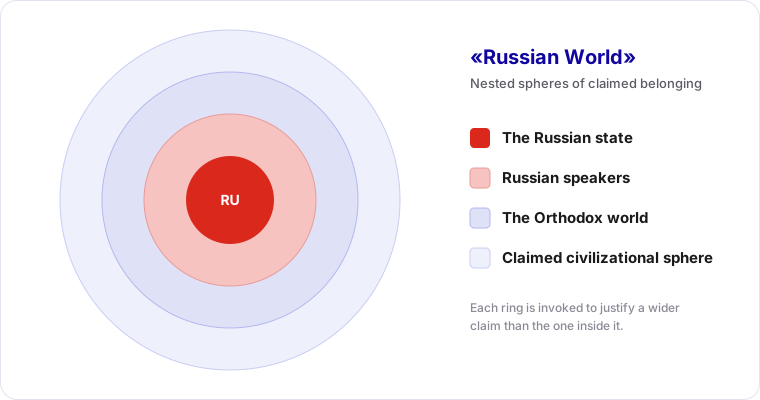
The doctrine also travels as mass culture. Oleg Gazmanov’s 2024 anthem “Russian World” sets the claim — and its irredentist threat against the post-Soviet states — to a stadium melody (English gloss above; the video makes no request to YouTube until you press play):
Why it matters
Section titled “Why it matters”Russkiy mir is the master key of contemporary Russian imperial ideology: it turns a cultural fact (the spread of the Russian language) into a political claim (a sphere of influence) and then into a moral imperative (the duty to defend it). Because the boundaries of the “Russian world” are undefined and defined by Moscow, the doctrine is infinitely expandable — it can be invoked to justify cultural programmes, the Foreign Agent suppression of rival influences at home, or outright invasion abroad.
It is also corrosive in a subtler way: by fusing nation, faith, and empire, it offers a sense of belonging and mission that is genuinely attractive to many, inside Russia and beyond — which is exactly what makes it effective as soft power and dangerous as a rationale for force.
See also
Section titled “See also”Sources
Section titled “Sources”- Laruelle, Marlene — The 'Russian World': Russia's Soft Power and Geopolitical Imagination, Center on Global Interests (2015). www.ponarseurasia.org/the-russian-world-russias-soft-power-and-geopolitical-imagination
- Suslov, Mikhail — 'Russian World' Concept: Post-Soviet Geopolitical Ideology, Geopolitics (2018)
- Putin, Vladimir — On the Historical Unity of Russians and Ukrainians, President of Russia (kremlin.ru) (2021). en.kremlin.ru/events/president/news/66181
- A Declaration on the 'Russian World' (Russkii Mir) Teaching, Volos Academy / Public Orthodoxy (2022). publicorthodoxy.org/2022/03/13/a-declaration-on-the-russian-world-russkii-mir-teaching
- Oleg Gazmanov — 'Russkiy mir' (official video), YouTube (2024). www.youtube.com/watch?v=RVrQUu7Vfuo
- Oleg Gazmanov: profile and sanctions (Canada, 2023; barred from Latvia/Lithuania), National Museum of the Holodomor-Genocide (2023). holodomormuseum.org.ua/en/propaganda/oleg-gazmanov-russian-singer
Mentioned in
Section titled “Mentioned in”- Anglo-Saxons
- Artificial State
- Banderites
- Collective West
- Compatriots Abroad
- Denazification
- Desatanization
- Gayropa
- Liberation
- Liberation of Europe
- Multipolar World
- NATO Expansion
- Near Abroad
- Novorossiya
- One People
- Passportization
- Peace Enforcement Operation
- Traditional Values
Footnotes
Section titled “Footnotes”-
Laruelle, M. (2015). The “Russian World”: Russia’s Soft Power and Geopolitical Imagination. Center on Global Interests — on the Russkiy Mir Foundation (established by presidential decree, 2007) and the diaspora-as-asset strategy. ↩ ↩2
-
Patriarch Kirill, address to the Third Assembly of the Russian World (2009): the “three pillars” of Orthodoxy, Russian language and culture, and common historical memory. ↩
-
Suslov, M. (2018). “‘Russian World’ Concept: Post-Soviet Geopolitical Ideology and the Logic of ‘Spheres of Influence’.” Geopolitics. ↩
-
Putin, V., “On the Historical Unity of Russians and Ukrainians,” President of Russia, 12 July 2021. ↩
-
“A Declaration on the ‘Russian World’ (Russkii Mir) Teaching,” Volos Academy / Public Orthodoxy, March 2022. ↩
-
Oleg Gazmanov, “Russkiy mir” (2024), official video. On Gazmanov’s sanctions (Canada, 2023), his entry bans to Latvia (2014) and Lithuania, and his performance at the 18 March 2022 Moscow rally for the annexation of Crimea: National Museum of the Holodomor-Genocide, “Oleg Gazmanov” profile. Quoted lines translated from the Russian original. ↩