
Genocide in Donbas
Tagswar justificationfabrication
EquivalentsRUгеноцид в Донбассе
Definition
Section titled “Definition”“Genocide in Donbas” is the unsubstantiated claim that Ukraine was carrying out a genocide against Russian-speaking civilians in the Donetsk and Luhansk regions — a charge Vladimir Putin invoked in February 2022 as a direct justification for the full-scale invasion. In his 24 February address he said Russia was acting to protect people from “genocide” by the Kyiv Junta.1
The accusation is the emotional engine of the war’s justification. It is designed to flip the moral roles: to recast an aggressor as a rescuer and an invasion as the prevention of mass murder.
Origin and history
Section titled “Origin and history”The claim grew out of the war that began in 2014, when Russia annexed Crimea and backed armed proxies in Donbas. Russian state media spent eight years describing the Ukrainian government’s response as a campaign of extermination against Russian-speakers, steadily escalating the language from “punitive operation” to “genocide.”
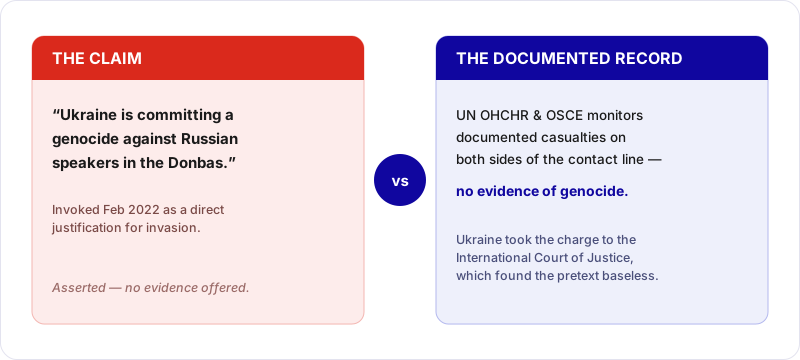
Independent monitoring tells a different story. The UN Office of the High Commissioner for Human Rights (OHCHR) and the OSCE Special Monitoring Mission documented the conflict in detail from 2014 onward: a war that killed roughly 14,000 people — combatants and civilians on both sides of the contact line — with civilian casualties caused by shelling from both sides, concentrated in 2014–2015.2 None of these bodies found evidence of genocide: no policy of destroying a national group, which is what the term legally requires.
The claim was then tested in court. Ukraine brought a case to the International Court of Justice arguing that Russia had abused the Genocide Convention by inventing a false genocide as its pretext for war. On 16 March 2022 the ICJ ordered Russia, by 13 votes to 2, to immediately suspend its military operations.3 In its 2 February 2024 judgment on preliminary objections, the Court confirmed it would proceed to examine claims under the Convention, while narrowing parts of the case.4
Function in propaganda
Section titled “Function in propaganda”The claim is used to:
- manufacture a humanitarian pretext for aggression, recasting an invasion as a rescue;
- invert the roles of aggressor and victim, so that the state starting the war appears to be stopping a crime;
- appropriate the gravest word in international law — “genocide” — to borrow its moral weight while emptying it of meaning;
- supply emotional fuel for the Special Military Operation and the Denazification frame, which together cast the war as a rescue from Nazi exterminators.
The claim is a fabrication. A real, ongoing genocide would have been visible to the international monitors who were present throughout — and they documented a war with casualties on both sides, not the one-sided extermination of a group. Misusing “genocide” in this way is not only false; by the finding the ICJ was asked to make, it turns the Convention meant to prevent atrocity into a cover for committing one.
A simple comparison figure can carry a lot of weight — the claim beside the documented record:
Key examples
Section titled “Key examples”The 24 February 2022 declaration. Putin’s invocation of “genocide” in Donbas was a centrepiece of the speech announcing the invasion, providing the humanitarian veneer for military aggression.1
Eight years of state-media escalation. From 2014, Russian outlets steadily built the “genocide” narrative, so that by 2022 the word would land on a prepared audience.
The ICJ proceedings. Ukraine turned the accusation back on Russia at the International Court of Justice; the Court’s 2022 order to suspend operations underscored that the “genocide” claim had no accepted basis.34
Why it matters
Section titled “Why it matters”The “genocide in Donbas” claim matters because it shows how propaganda weaponises the very language created to prevent atrocities. By accusing the victim of the aggressor’s own crime, the Kremlin both motivates its public and pre-empts criticism: those who document Russian atrocities can be dismissed as deniers of the “real” genocide.
The misuse also has a corrosive long-term cost. Each cynical invocation of “genocide” erodes the word’s power, making it harder for the world to respond when genocide is actually occurring — a damage that outlasts any single war.
Naming it accurately
Section titled “Naming it accurately”A quick reference for reporting — what to write instead of the Kremlin’s framing.
See also
Section titled “See also”Sources
Section titled “Sources”- Address by the President of the Russian Federation, 24 February 2022, President of Russia (kremlin.ru) (2022). en.kremlin.ru/events/president/news/67843
- Report on the human rights situation in Ukraine, UN OHCHR (2022). www.ohchr.org/en/countries/ukraine
- Allegations of Genocide (Ukraine v. Russian Federation) — Order on Provisional Measures (16 March 2022) and Judgment on Preliminary Objections (2 February 2024), International Court of Justice (2024). www.icj-cij.org/case/182
Mentioned in
Section titled “Mentioned in”- Biolabs
- Compatriots Abroad
- Denazification
- Kyiv Junta
- Liberation
- Passportization
- Peace Enforcement Operation
- Russophobia
- Separatists
- Special Military Operation
Footnotes
Section titled “Footnotes”-
Address by the President of the Russian Federation, 24 February 2022 (kremlin.ru), invoking “genocide” in Donbas. ↩ ↩2
-
UN OHCHR reporting on the human rights situation in Ukraine: the 2014–2022 conflict caused casualties on both sides of the contact line (roughly 14,000 dead overall), with no finding of genocide. ↩
-
ICJ, Allegations of Genocide (Ukraine v. Russian Federation), Order on Provisional Measures, 16 March 2022 — Russia ordered (13–2) to suspend military operations. ↩ ↩2
-
ICJ, Judgment on Preliminary Objections, 2 February 2024 (case no. 182). ↩ ↩2